
Enviroquest
Harrisburg, Pennsylvania
Testing, mitigation and existing-system service for central Pennsylvania homes and commercial properties.
DEP mitigation firm ID 1725Listed September 1, 2026
View company profileRadon mitigation in Hershey, PA reduces indoor radon with a system designed for the home’s foundation. Explore 1 local service profile, Dauphin County radon information, testing options and installation costs.
Companies serving your area
Enviroquest is listed below. These are source-based profiles, not a quality ranking.
Testing, mitigation and existing-system service for central Pennsylvania homes and commercial properties.
DEP mitigation firm ID 1725Listed September 1, 2026
View company profileEnviroquest expressly lists Hershey coverage and offers residential services as well as school and institutional radon management. The types of buildings are different: a homeowner can use the residential listing, while a school or larger-property manager should establish the appropriate project scope with the provider.
| Company | Office base | Published services | Evidence |
|---|---|---|---|
| Enviroquest | HarrisburgServes this area; office elsewhere | Radon mitigation, Radon testing, System repairs, Passive activation | Coverage source |
A service-area listing does not establish availability at every address. Current certification should be checked through Pennsylvania DEP.
Testing is the only way to establish the radon level in your home. Radon is a radioactive gas you cannot see, smell or taste. Long-term exposure increases lung-cancer risk. The EPA estimates about 21,000 radon-related lung-cancer deaths per year across the United States; this is a national risk estimate, not a death count for Hershey.
According to Pennsylvania DEP, approximately 40% of homes tested in Pennsylvania had radon above 4 pCi/L. This statewide testing summary does not establish the percentage of affected homes in an individual city, county or neighborhood.
| Scope | Figure or classification | What it means |
|---|---|---|
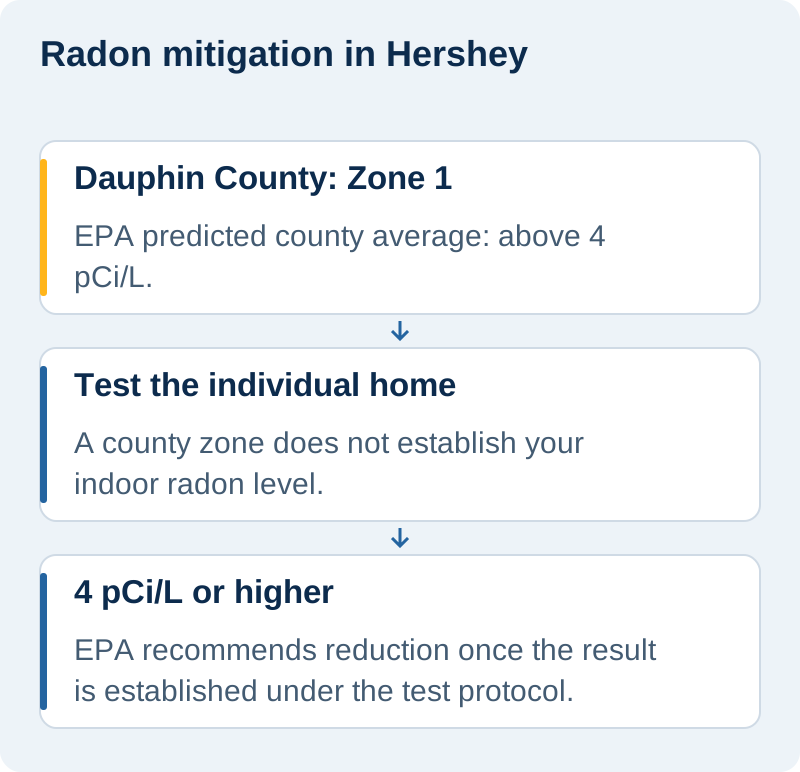
| Dauphin County | Zone 1: above 4 pCi/L | EPA predicted average indoor screening level for the county, not a current city average or a home test. |
| Pennsylvania tested homes | About 40% above 4 pCi/L | Statewide DEP summary of tested homes, not a local prevalence estimate. |
| EPA action level | 4 pCi/L or higher | Reduce radon when the result is established under the appropriate testing protocol. |
| EPA lower-level guidance | 2 to below 4 pCi/L | Consider reduction. The action level is not a boundary between risk and no risk. |
Dauphin County is in EPA Zone 1. This supports taking testing seriously in Hershey, but it cannot establish whether a particular home needs a mitigation system. Use the property's test result for that decision.
County classification: EPA Pennsylvania radon map. The county planning map dates to 1993; its zones are not a current survey of local homes.
Use a home radon test kit or hire a Pennsylvania-certified radon testing provider. Choose the method for the purpose of the test, particularly if a property transaction has a required protocol.
The radon testing guide explains test duration and follow-up. DEP also lists eligibility-based test-kit programs; check the program conditions before assuming a free kit is available.
Health, testing and action-level sources checked September 22, 2026: EPA health risk, EPA action guidance and PA DEP home testing information. pCi/L means picocuries per liter.
The PA DEP ZIP-code radon report is the official starting point for available measurements in a postal area. Check the measurement period, floor level and sample size before interpreting an average. A ZIP-code summary and nearby readings cannot replace testing the property.
Yes. Changes to foundations, ventilation or the use of lower-level rooms can change the conditions under which an earlier result was obtained. Keep the existing test report and system information, and follow retesting guidance after substantial alterations. A past low reading does not describe every future building condition.
Sources: Local provider or public-health information and EPA reduction guidance.
$800 to $1,200 per system is Pennsylvania DEP’s typical statewide installation range from January 2026. Use it as a starting point for a home in Hershey. Multiple foundation areas, crawl-space membranes and difficult vent routes can increase the work.
Home test kits cost about $20 to $30 each. The full cost breakdown also covers electricity, replacement fans and a first-year budget example.
Source: PA DEP 2026 cost guidance. These are state benchmarks, not a measured city price average.
Testing measures exposure, installation reduces it, and repair addresses an existing system. Choose the service that matches the property’s current situation.
| Your situation | Service needed | Listed provider information |
|---|---|---|
| No usable radon result | Radon testing | Enviroquest |
| Confirmed elevated result | Mitigation assessment and installation | Enviroquest |
| Fan problem or elevated result with an existing system | System assessment or repair | Enviroquest |
A confirmed result of 4 pCi/L or higher calls for reduction under EPA guidance; at 2 to below 4 pCi/L, consider reduction. The appropriate follow-up depends on the test method and purpose.
The testing guide explains short-term and long-term measurements. For installation choices, see systems for different foundations. Prices and their source limitations are explained in the Pennsylvania cost guide.
Action level: U.S. Environmental Protection Agency.
Harrisburg, Lancaster, Mechanicsburg have their own local service pages in this directory.