How much does a radon mitigation system cost in Pennsylvania?
$800 to $1,200 per installed system is the typical range published by the Pennsylvania Department of Environmental Protection in January 2026. The final price depends on the foundation, number of collection points, pipe route and access for installation.
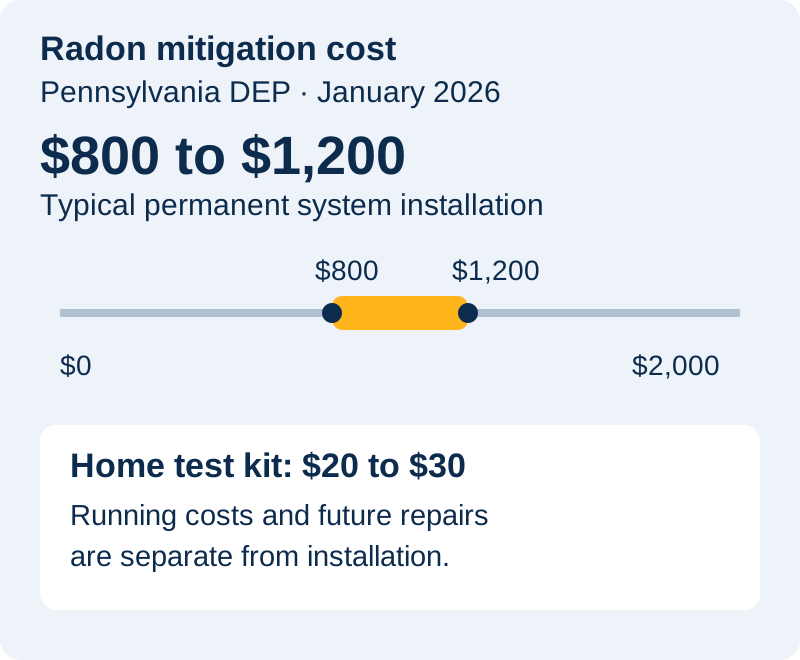
Source: PA DEP, January 12, 2026. This is statewide consumer guidance; complex installations can cost more.
| Expense | Planning figure | What it covers |
|---|---|---|
| System installation | $800 to $1,200 per system | PA DEP’s 2026 typical range for permanent mitigation. |
| Home test kit | $20 to $30 per kit | PA DEP’s 2026 kit guidance. Check whether laboratory analysis and return postage are included. |
| Fan electricity | $53 to $158 per year in the example below | A 40 to 120 W fan at an assumed $0.15/kWh. Your fan and tariff determine the actual bill. |
| Fan replacement | $200 to $350 including parts and labor | EPA’s published national benchmark; obtain current pricing for the installed model. |
| Retesting | $20 to $30 per home kit at the DEP benchmark | Separate from professional test fees. EPA recommends retesting at least every two years. |
Price sources: PA DEP installation and kit guidance; EPA fan replacement and retesting guidance. Electricity figures are calculations, not a surveyed average.
What makes a radon installation more expensive?
Multiple foundation areas, difficult pipe routes and crawl-space membranes add materials and labor. Floor area matters when it changes the collection design, but square footage alone cannot tell you the number of suction points or the required fan.
| Home condition | Work the system may need | Effect on the project |
|---|---|---|
| One accessible concrete slab | A suction point beneath the slab, sealed penetration and vent route | Usually a simpler layout to assess and install. |
| Basement plus exposed-soil crawl space | Sub-slab collection plus a sealed crawl-space membrane and suction beneath it | More collection and sealing work than a slab alone. |
| Additions or separate slabs | Diagnostic checks and potentially additional suction points | More pipework or a different system layout. |
| Finished basement | Carefully planned routing around occupied rooms and finishes | Access and making good disturbed finishes can add labor. |
| Existing passive system | Assessment of existing pipework and collection, then fan activation if suitable | Reuse may reduce work, but a fan alone cannot correct every layout. |
System methods: EPA Consumer’s Guide to Radon Reduction.
How much electricity does a radon fan use?
A 60 W fan running continuously uses 525.6 kWh per year, costing about $79 at $0.15/kWh. Use the fan’s rated watts and the electricity price on your own bill for a household estimate. The fan is intended to stay on continuously.
| Example fan power | Annual use | Annual fan electricity |
|---|---|---|
| 40 W | 350.4 kWh | $52.56 |
| 60 W | 525.6 kWh | $78.84 |
| 90 W | 788.4 kWh | $118.26 |
| 120 W | 1,051.2 kWh | $157.68 |
Calculation: watts ÷ 1,000 × 24 × 365 × electricity rate. These examples exclude any heating or cooling losses, repairs and testing. At a different tariff the cost changes proportionally: a 60 W fan at $0.20/kWh costs about $105 per year.
How much should you budget for the first year?
$919 to $1,339 is an illustrative first-year budget using the DEP installation range, two $20 to $30 kits and a 60 W fan at $0.15/kWh. It is a worked budget, not a package sold by this directory.
- Installation: $800 to $1,200.
- Two home kits, before and after work: $40 to $60 if both are needed and neither is included.
- One year of example fan electricity: approximately $79.
Professional testing, electrical changes, finish repairs or a more complex system can increase the total. If the installation already includes the post-mitigation test, do not add that same test twice.
How much does replacing a radon fan cost?
About $200 to $350 including parts and labor is the EPA’s published replacement benchmark. Actual pricing depends on the fan, access and any changes needed to connections or pipework. A repair provider should diagnose the system before treating a high radon result as a fan-only problem.
Source: EPA system-maintenance guidance. This national figure is not a guaranteed Pennsylvania repair price.
Does a high initial radon reading automatically mean a larger fan?
No. The foundation’s airflow and pressure requirements determine the system design. A high reading identifies an exposure problem, but it does not specify fan power. An isolated slab or an unsealed crawl space may need better collection rather than simply a stronger fan.
Read the system types guide to understand those differences. After installation, a radon test measures the outcome.
Is a home test kit the same as professional testing?
No. A kit is a self-administered measurement; professional testing is a separate service. A property sale may require a particular professional protocol and report. The $20 to $30 kit figure should not be used as the expected price of a professional appointment.
For an installer or tester, browse Pennsylvania company profiles and the local service-area pages. Confirm current certification in the relevant service category.
Sources reviewed September 22, 2026.